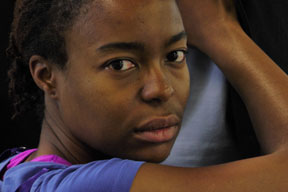
Reflections: Philadelphia performance, Clark Park, 2008

Notes from Clark Park performance, Philadelphia, by Human Landscape Dance 7_12_08

Really nervous today! We wake up early and load platforms on the top of the car. Jen gets Maya ready because I'm too jittery to focus. We somehow manage to get on the road on time.

We pull up to Clark Park and I am struck by how empty it is. There is no one around in the big, gorgeous bowl at the center of the park. I had envisioned performing here, where we could be seen from many sides. It is clear where the people are, however: they are all gathered at the farmer's market in the northern corner. We lug the equipment up there instead.

Clark Park is a rolling, green oasis in bustling Philly. It has plenty of room for dogs to run, trees to lounge beneath, and a playground. The northern end has sculptures and paved areas: it is the more urban end. On the Western edge stands a small, concrete house painted white with green squiggles--a gingerbread storehouse.

It is an overcast day, but not raining. Outdoor shows can be tricky: a little bit of rain or a little too much heat will drive away an audience. Overcast works in our favor, however. The farmer's market bustles.

This performance is part of Human Landscape Dance's Out of Bounds program. By holding free performances in public spaces, we help educate the public about contemporary dance. We aim to dispel the myth that concert dance is remote or only for snobs with blue blood and monocles. Dance is done with the body and that's how it resonates with audiences: we feel dance in our bones and muscles, in our thumping hearts and tapping toes--it's a human connection. Human Landscape Dance brings dance to where the people are, rather than always expecting people to come to us.

The first dance is a bit shaky. "Falling Behind" is our premiere. It has not yet sunk deep into our bodies. We have a good run, but it does not yet look entirely spontaneous, as if we had improvised it on the spot. "Falling Behind" takes place on a sidewalk. The dancers follow the linear track that mirrors how we envision the unfolding of our lives. At the end, one dancer draws a line across the sidewalk in chalk. She continues on, leaving the others behind.

Our performance is called Rituals of the First Year. They are dances created out of my first year's experience as a dad. Maya plays on the grass or a blanket. Her mom, Jen, carries her to the farmer's market, or to watch us, or to play someplace new. Maya is in good humor, but clearly tired. She has not napped since early this morning: too excited to be on the road.

Our second dance, "Coming Unstuck," depicts a family of three trying, but unable, to sleep. They rock the baby, jerk awake in surprise, or roll around. They lie standing up against a wall, a metaphor for the futility, some nights, of trying to sleep with an infant. This is a more familiar piece and they perform it well. There is a movement theme of shaking or rocking and, at one point, a truck, stuck in traffic, honks its horn in time to the vibrations of the dancers. It is the kind of serendipitous punctuation that you cannot plan and which can only happen when performing outside of a theater.

My solo, "Looking Over My Shoulder," is our weakest piece, at least it feels that way to me. Half of my frustration is performing it myself. I love to perform, but, as a choreographer, I can't stand not seeing the work from the same perspective as the audience. I feel blind! Yet the dance is exciting enough: I am tied to a tree and must free myself. At first, I carefully unwrap myself, then fling myself away--only to be snapped back by the cord. I then coil myself up tighter in the rope and, by pulling off my shirt, manage to slip the rope off too. The dance shows my struggles to balance my work life and home life with a baby. I have to strip off my old expectations of productivity.

The audience ebbs and flows. A few stay the whole time; most drift in and out on their way to or from the stalls. This answers the primary goal of our public space performances: we allow the people who use the space everyday to see it anew as a work of art. We hope this gives them a new sense of the relationship between art and life. For me, the concepts are fused. I see art every time I look out the window.

Our last piece is our oldest piece. "Leaving Home" is about birth. The dancers slowly awaken within a fabric egg. Blind at first, they find each other by touch: sometimes soft and sometimes hard. They learn to use their bodies over time, coming to standing only halfway through. By the end, two have broken free of the egg, but one remains stuck. This character is me: reluctant to change, needing the help of friends or family to transition.

I am drained and pleased. I chat with the reviewer about the dances, and with Anne-Marie Mulgrew, a Philly choreographer with a legacy of site-specific work. I reluctantly return to pack up the gear. We have a few hours to shower and rest before supper. Jen goes on ahead to try and put Maya down at our friend's place.

In the car afterward, a wave of relief and grief hits me. It is always this way, a mixture of strong emotions in the aftermath: joy and pain, dismay, pleasure…every feeling I have been putting off feeling until later. My muscles start to release their accumulated tension. I start to drive slower. When I get to the address, I park and just sit for a few minutes, watching the street with slack jaw and dead eyes--zombie at rest.